
Rehousing and Arrangement
Updated 04-10-2026
Arrangement
Arrangement information was taken in part from the Arizona State University Processing Manual, March 2015.
Archival collections can be arranged either during or after rehousing.
When organizing a collection, materials may be arranged into series and subseries based on groups of materials with similar functions or other shared characteristics or based on groups of materials that should be separated from each other.
If a collection arrives with an existing order or arrangement (“original order”), the arrangement should be preserved. Original order can give insight into how the original creator(s) of a collection thought or used the materials.
If a collection arrives with an inventory, review the inventory and keep it available during processing.
If a collection arrives with no apparent order, or if the existing arrangement would present unreasonable obstacles to research, the processor should arrange the collection during processing. The goal of arrangement is to make the collection usable for researchers. Consult with colleagues before reorganizing a collection.
Arrangement usually follows one or more of these guidelines:
- Subject materials are grouped based on similar or related topics
- Chronological order (oldest to newest)
- Material type (photographs, papers, audiovisual materials, etc.) See Creating Series and Subseries below for more information.
Any reorganization should be detailed in the Processing Information or Arrangement notes.
Creating Series and Subseries
Series and subseries are typically formed based on the following categories:
- Format
- Photographs
- Media
- Journals
- Correspondence
- Function
- Business papers
- Research papers
- Legal papers It is common for a collection to include both format- and function-based series.
Small or simple collections might not need series or subseries, which exist to make collections more manageable and useful to researchers.
Arrangement of Series
Series should be logically arranged within the collection. Factors to consider:
- Most useful to researchers placed first
- Size of collection
- Papers first, media last
- Alphabetical order
Number series and subseries with either Roman numerals or Arabic numerals. Subseries should start over at 1 or I when a new series starts.
Example:
- Series 1: Correspondence
- Subseries 1: Memos
- Subseries 2: Letters
- Series 2: Media
- Subseries 1: Photographs
- Subseries 2: Films
Rehousing
If collection was not rehousing during accessioning, do so during processing (before completing the ArchivesSpace spreadsheet). Many materials arriving in Special Collections and Archives are not in archive-safe folders and boxes (housing) and need to be rehoused. Below is a recommended path for arrangement and rehousing of materials, but this process can vary depending on the collection.
Use only pencil when writing on folders. Some other materials may need to be marked with marker or pen, but be sure to consult with Spec staff/faculty before doing so.
- Foldering
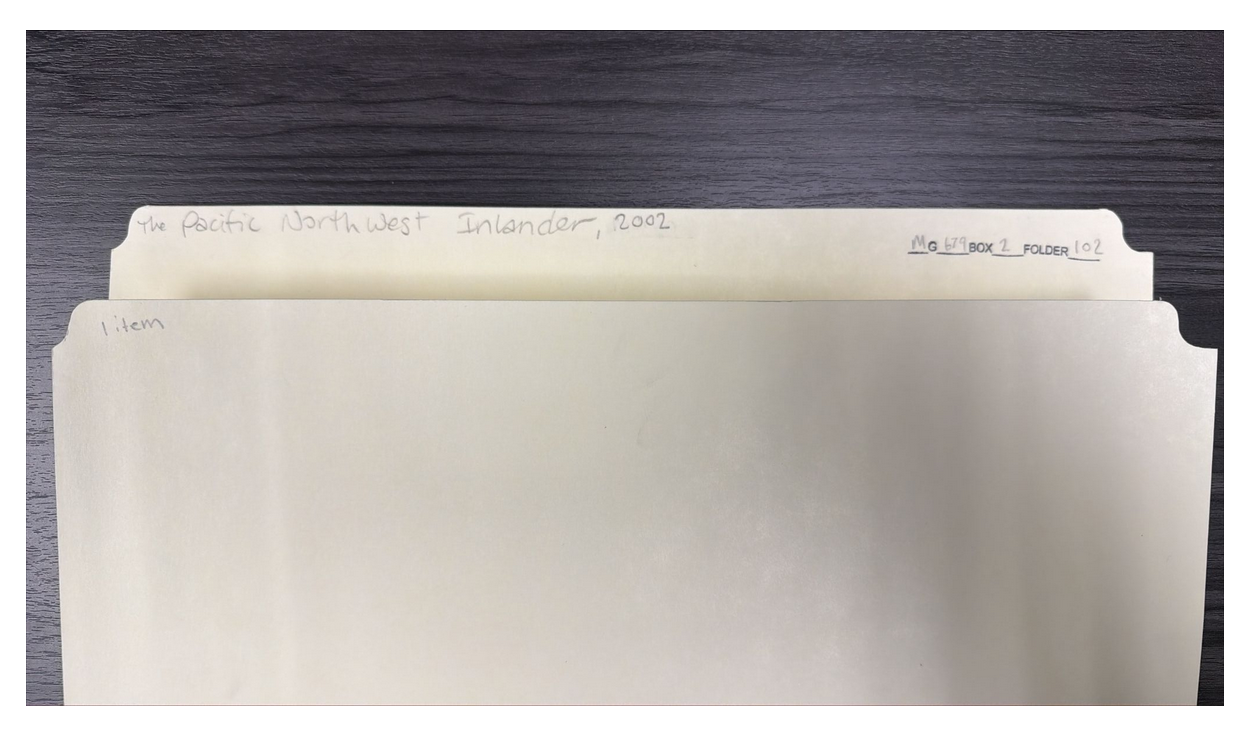
- Materials may come in folders that have important information about the collection written on them. Replace these folders with acid-free folders (legal or letter sized, depending on the size of the largest item in the folder). Transcribe any information from the old folder to the new folder, on the front face.
- Fold the folder along the pre-scored line that fits the materials inside.
- Do not over-fill folders. If materials cannot fit within a single folder folded along the largest score line, put materials in multiple folders. Use the same folder title, but add numbers (e.g., “1 of 2”). -The folder title should go in the upper left corner of the folder tab.
- Staples and Clips:
- Do not try to remove staples - this can cause more damage than leaving the staples in place. If the staples are posing a real danger to the materials, consult with colleagues.
- Remove paper clips and binder clips. If the clips were holding together small groups of papers, replace with a Plastiklip. Larger groups of paper: either place in their own folder, fold a strip of acid-free paper around one edge of the “packet”, or rotate the “packet” 180 degrees to indicate that they are separate from surrounding groups of papers.
- Duplicate Materials
- Retain only one or two copies of true duplicates. A copy is not considered a duplicate if it has characteristics that distinguish it from other materials (notes in the margins, signed by the author, etc.). Please consult with colleagues if you have questions about which materials to retain.
- Sensitive Materials
- Spec typically does not retain sensitive materials that cannot be made available to researchers. Sensitive materials include:
- Social Security Numbers
- Banking information (checks, credit card statements, account numbers, etc.)
- FERPA-protected information (student information)
- HIPAA-protected information (medical information)
- Other Personally Identifiable Information (taxpayer ID, fingerprints, and more)
- Determining whether to retain sensitive information is an evaluation of the value of historical information versus the risk of exposure. Please discuss with colleagues. If sensitive materials are retained, note the materials and reason on the front of the relevant folder. Also add a note to the ArchivesSpace spreadsheet in the Physical Description field.
- Spec typically does not retain sensitive materials that cannot be made available to researchers. Sensitive materials include:
- Confidential Materials
- Currently being developed
- Damaged Materials
- Damage can include mold, water damage, tears, bugs, etc. Check with a colleague for the best strategy for moving forward. Remediation is possible in some cases. If damage cannot be remediated, the materials will be disposed of.
Folder Labeling
Folder labels should include folder title; date(s) of materials included in the folder; collection, box, and folder numbers; and number of items within the folder. Some of this information will not be available until all materials have been arranged and housed.
- Title (upper left of tab): Brief description of materials in the collection. A common formula is topic + format (“Kibbie Dome construction photographs”, “ILA conference notes”, “CALS correspondence”), but title can vary greatly.
- Date (center of tab): Date(s) covered by the materials in the folder. Write as “DD-Month-YYYY”, “Month YYYY”, “YYYY”, or “YYYY-YYYY” or “Month YYYY-Month YYYY” if there is a date range.
- Collection, box, folder numbers (upper right of tab): Use the Spec Folder stamp (often found in the processing room cabinets). This stamp includes fields for standard information:
- _G: Fill in M, U, IJC M, or P to indicate that the collection is MG, UG, IJC MG, or PG.
- __: Fill in the collection number, based on the List of All Processed Collections spreadsheet.
- Box __: Enter the sequential box number the folder is in.
- Folder __: Enter the folder number.
DO NOT restart folder renumbering when you move to a new box. Restart folder numbering only when starting a new series (series continue regardless of boxes).
Bound Materials
If you come across bound materials (books, scholarly journals, etc.) while processing, look through the item for any notes or marks that make the item individually significant.
If the item does not have any unique characteristics, check the title against the Library catalog to see if Spec already holds a copy.
- If a copy exists in Spec holdings, the item can be deaccessioned from your collection. Check the deed of gift - if the donor wants to have any discarded materials returned to them, do so; otherwise, the item can be added to the free shelf.
- If a copy does not exist in Spec holdings and matches collecting scope, pass the item to the Special Collections Librarian (Kelley) for cataloging.
- If a copy does not exist in Spec holdings and does not match collecting scope, deaccession from the collection and either return to donor or add to free shelf.
If the item does have unique characteristics and would best serve researchers as part of the collection, keep the item in the collection. Any identifying information can be written on the upper right corner of the item or on an acid-free bookmark (preferred).
Photographs
Photographic materials include prints, film negatives, and glass plate negatives. Metal negatives are rare.
Housing depends on the item material:
- Printed photographs can typically go in normal archival folders. Acid-free buffer paper or poly sleeves can be used if necessary.
- Film negatives should go in poly sleeves or acid-free paper envelopes, depending on the size. The fit should be neither too snug nor too loose.
- Glass negatives should go in an acid-free wrapper or envelope.
Each sleeve should be labeled with a brief description, collection number, and box number.
See Photo Negatives and Prints for more information about deteriorating photographic materials. If negatives are cracking, warping, or emitting a vinegar smell, discuss with colleagues. Some materials can be placed in cold storage to slow deterioration. Other might need to be digitized and disposed of.
Objects
Some collections include objects or artifacts (three-dimensional materials). Discuss retention and housing of such items with colleagues.