
RECA Claims Resources
RECA Form for Patrons
Links to Form
- Spec form that RECA patrons should fill out: Request for Assistance with RECA Claim
- Simple URL: https://go.uidaho.edu/reca
Suggested Email Language When Directing Patron to Form
Make sure links work:
| Dear [patron], Thank you for contacting Special Collections and Archives at the University of Idaho. We have a collection of Idaho directories that we can look through to help with your supplemental proof of residence documentation for the RECA (“Downwinders”) application. To help us answer RECA-related requests more efficiently, please submit your request using our online form: Request for Assistance with RECA Claim. This will ensure that we have all the information needed to begin our search. Due to the volume of recent Downwinders requests, it may take up to six weeks to process your request. We appreciate your patience while we assist you. Please let us know if you have any questions about completing the form. |
RECA Responses Spreadsheet
- RECA form response spreadsheet: RECA Requests
Researching a RECA Claim
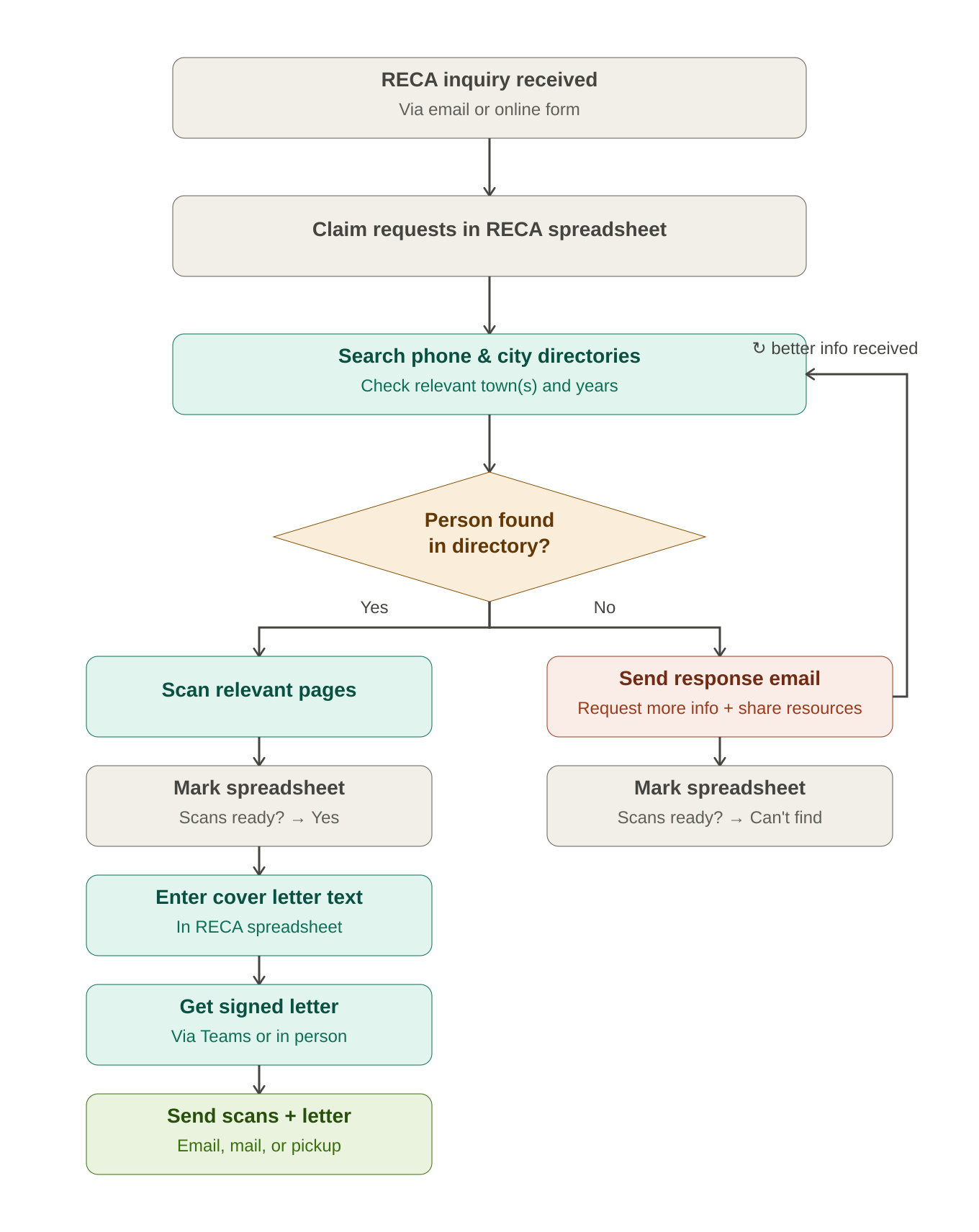
Background
In July 2025, the federal government expanded the Radiation Exposure Compensation Act (RECA) to provide financial compensation to individuals who lived anywhere in Idaho between 1951 and 1962 and subsequently developed certain kinds of illnesses. Claimants, also called “Downwinders”, may qualify for compensation if they can establish that they were diagnosed with a relevant illness and lived in Idaho between 1951 and 1962.
The University of Idaho Special Collections and Archives (Spec) holds a collection of telephone and city directories: IDTELE. The residency information in these directories can be helpful evidence that a Downwinder patron lived in Idaho in the 1951-1962 period. Spec can provide certified copies (inclusion of a cover letter signed by the department head).
What We Need From Patrons
Patrons should supply the following via the Request for Assistance with RECA Claim (or Spec employees can fill in the spreadsheet directly):
- Claimant name, email address and/or phone number
- Name(s) of person whose residency is in question, including maiden names, other names they were known by, parents’ names (if they were a minor)
- Town(s) in Idaho where they likely resided
- Whether the claimant is filing by mail or online; if by mail, record mailing address
| Spec Collections that may include Proof of Presence documentation |
| - Idaho Telephone and Business Directories (IDTELE). Finding aid. Directories database - University of Idaho Student Directories. Finding aid. - Idaho High School and College Annuals. Finding aid. - The Idaho state brand book. Idaho SF101.I3 |
Locating Directory Information
- Make sure that you’re familiar with the “Using Telephone and City Directories” below and/or Instructions for researching a RECA claim (SharePoint): Downwinder (RECA) reference questions
- Consult the IDTELE finding aid and/or the University of Idaho Spec Directories site to determine which directories include the town you’re looking for
- Pull the relevant items from the directories section of the rare books room (Moscow and University of Idaho directories are in the Reading Room)
- Look through listings for the name(s) that the patron provided. If you cannot find the person, consider alternative sources based on the information in “Using Telephone and City Directories” below
Using Telephone and City Directories (reference & search tips)
| Telephone books | City directories |
| Published by telephone companies | Published by directory companies |
| Includes anyone with phone service; excludes people who did not have telephone service | Information often collected by door-to-door surveys and postal route information |
| May include name, address, and phone number | May include name, spouse’s name, address, phone number, occupation, employer (varies widely). For rural residents, may include just name and rural mail delivery route number (“Rural Route”) |
| May include listings for multiple towns and nearby rural areas. Areas included tend to be determined by geographic proximity - which communities were closest to each other, regardless of county lines, and sometimes regardless of state lines | Typically focused on a single city plus surrounding small towns and rural areas. Coverage unlikely to cross county/state lines. Sparsely-populated counties unlikely to be covered by city directories. |
| Do not include reverse lookup sections | Often include reverse lookup sections, organized by address first or phone number first |
Telephone and city directories may NOT include:
- Minors
- People who moved frequently
- People without phones
- People in very rural areas
- Anyone who opted out of being listed
Tips for searching
- Both telephone books and city directories may include listings for multiple towns and surrounding rural areas. Our IDTELE finding aid and University of Idaho Spec Directories site indicate which towns are included in which directories. For example, listings for Burke are included in the Wallace directories.
- Telephone and city directories often have multiple sections of listings that encompass nearby towns and rural areas. If you can’t find the person you’re looking for in the town provided by the patron, try looking in other sections of the same directory.
- A city directory may have multiple rural routes listed, so be sure to look through each rural route.
- If you can’t find the person you’re looking for, check for other family members they might have lived with (Ancestry.com can be helpful in establishing connections).
- Married women are often listed under their husband’s name, but they are frequently not listed at all (especially in phone books). You might see something like “Smith, John (Mary)” or “Smith, John (Mrs. John Smith)”.
- People with very common names (John Smith, George Johnson, etc.) might require additional identifying information to confirm.
- People might appear with different spellings (directory publishers can make mistakes!), nicknames, or initials only.
- Check multiple years: if someone isn’t listed for one year, check the year before or after – they might have moved into or out of the area.
- Genealogical sites such as Ancestry and FamilySearch may have information that provides leads.
Scanning Directories
If a directory includes the person you’re looking for:
- Scan the directory:
- Phone book: Scan the front cover, title page, and relevant internal listings of the directory
- City directory: Scan the title page, the page that explains abbreviations, and the relevant internal listings
- NOTE: For both types of directories, be sure that either the front cover OR the title page shows the directory’s year.
-
Name the file so it accurately reflects city/town, year, and directory type (ex.
jerome_phone_1959.pdf) - Enhance the image:
- Crop the scans in the scanning program to show just the page you need, removing any part of the scanner bed or other pages captured in the image (Zeutschel: Crop>Crop)
- If the directory’s pages are darkened, increase the contrast of the scan (Zeutschel: Optimize Image>Contrast). These two steps will make the final printouts more readable by creating more contrast between the text and the rest of the page
Do not highlight listings. Do not alter the scans in any way.
Student workers: at this point, send scans to a Spec staff or faculty member.
Cover Letters
In the RECA Requests spreadsheet, enter cover letter language into the “Text for cover letter” column. Edit the following template to reflect appropriate names, places, dates, and collections used.
Cover letter template:
| To [claimant full name]: Following the completion of your research inquiry with the University of Idaho Library Special Collections and Archives, page scans have been provided to you from the telephone directory [or city directory] for [town name] published in [date(s)]. The scans were made from original directories within the University of Idaho Library’s IDTELE collection. The documentation provided containing [# of scanned pages] pertaining to [person name] of [town name, Idaho,] are a true and accurate copy of a record kept in our files. |
Cover letter example:
| To John Smith: Following the completion of your research inquiry with the University of Idaho Library Special Collections and Archives, page scans have been provided to you from the city directories for Boise, Idaho, published in 1956, 1957, and 1958. The scans were made from original directories within the University of Idaho Library’s IDTELE collection. The documentation provided containing 9 pages pertaining to Jane Smith of Boise, Idaho, are true and accurate copies of records kept in our files. |
Dulce will provide cover letters via Teams (for digital-only requests) or in person (for “by mail” requests).
Responding to the Patron
Successful Searches
According to the patron’s request, either email the scans and cover letter as attachments, or print out the materials to be mailed or picked up in person. If you are not printing out listings scans for the patron, send the scans as email attachments and include a “Dear patron…” insert with the mailed cover letter.
Do not record Downwinders requests in the Patron Support Form. Metrics will be calculated via the RECA spreadsheet.
Suggested email language for sending documents as email attachments:
| Dear [patron name], Thank you for submitting your request for residency documentation. We found listings for [person name] in the directories for [place name] in [years]. Please find attached scans of these listings, as well as a certifying cover letter from the head of my department. The University of Idaho Library was pleased to provide documentation that could support your RECA claim for Downwinder benefits. Over the past year, the Library has received approximately 100 of these requests each week, and we recently added a part-time staff member to help meet this growing demand. As part of our commitment to serving communities across Idaho and beyond, we provide this service free of charge. If you found our work valuable, we invite you to support the Library’s archive department with a gift of $25, or any amount that is meaningful to you. Your generosity helps ensure that we can continue providing expert research assistance and archival resources to our communities. To make an online gift, please visit the U of I Giving website here. If you have any questions or concerns, please let me know. Sincerely, [employee name] |
Suggested email language when you’re sending mailed cover letter and emailed listings scans:
| Dear [patron name,] Thank you for submitting your request for residency documentation. Please find attached scanned pages from the [place name] directories, published in [years], in which [person name] of [place name] is listed. If you do not have access to a printer to print out these attachments, please let me know. I have mailed you a cover letter to include with these scans as part of your RECA claim. It should arrive within the next two weeks. The University of Idaho Library was pleased to provide documentation that could support your RECA claim for Downwinder benefits. Over the past year, the Library has received approximately 100 of these requests each week, and we recently added a part-time staff member to help meet this growing demand. As part of our commitment to serving communities across Idaho and beyond, we provide this service free of charge. If you found our work valuable, we invite you to support the Library’s archive department with a gift of $25, or any amount that is meaningful to you. Your generosity helps ensure that we can continue providing expert research assistance and archival resources to our communities. To make an online gift, please visit the U of I Giving website here. If you have any questions or concerns, please let me know. Sincerely, [employee name] |
Resources for Unsuccessful Searches
If you cannot find the person you’re looking for in the directories, you may use the following suggested email language, inserting appropriate names, places, dates, etc.:
Make sure links work
| Thank you for submitting your request for residence documentation for [Person Name] of [Place Name]. Unfortunately, we were unable to find listings for [Person Name] in our [Place Name] directories. If you have any other ideas about where [Person Name] might have lived in Idaho during the 1951-1962 period, or if there is a parent or other close relative of the person we can look for, please let me know. If you have not done so already, I suggest contacting the Idaho State Archives (https://history.idaho.gov/archives/reca/), which has its own collections that may be helpful with residence documentation. You might also consider checking out the Idaho Downwinders Support Group on Facebook. It is run by Tona Henderson, who knows far more about Downwinders cases than we do. Tona’s email is tonahenderson@hotmail.com. Please let me know if you have any questions or concerns. |
NOTE: If the patron requested that you look up a woman or minor, ask if there is a male head of household (father or husband) we might look for instead. Residency can be established by providing these kinds of listings along with marriage/birth certificates from the county or state.
Outside Resources
Feel free to recommend the following resources to patrons as well:
- Idaho State Archives Downwinder form: https://history.idaho.gov/archives/reca/
- Telecommunications History Group https://www.telcomhistory.org/. Note: they may charge for lookups.
- RECA information from the U.S. Department of Justice, including a link to the online claim portal: Radiation Exposure Compensation Act
- Tona Henderson: tonahenderson@hotmail.com or 208-365-2669
- For military records (Mountain Home AFB, for instance) and other federal records, suggest Senator Crapo’s office: https://www.crapo.senate.gov/contact
- People looking for Basque ancestors in Idaho:
- Amaya Herrera, Basque Museum: amayah@basquemuseum.eus or (208) 343-6959
- Basque Museum general line: (208) 343-2671
Digitized Directories
Last updated 08-17-26
Directory communities fully digitized: